
Chuck Holloway: Yesterday, Today and Tomorrow
If you are new to the Oregon bluegrass community, you might know Chuck Holloway as the banjo player in Thunder Ridge and a key member of KBOO Radio’s Music from the True Vine show.
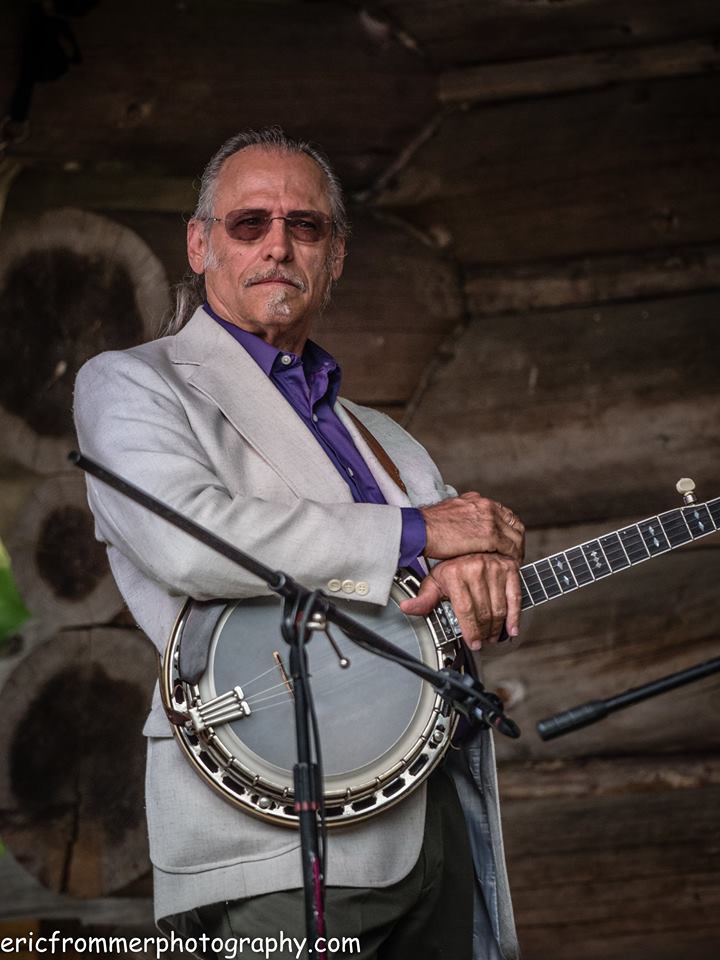
If you have been involved for a while (say, decades), you might know him as a former Oregon Bluegrass Association president, a Eugene radio programmer, a member of various bands throughout the Willamette Valley, and a keeper of the flame of traditional bluegrass.
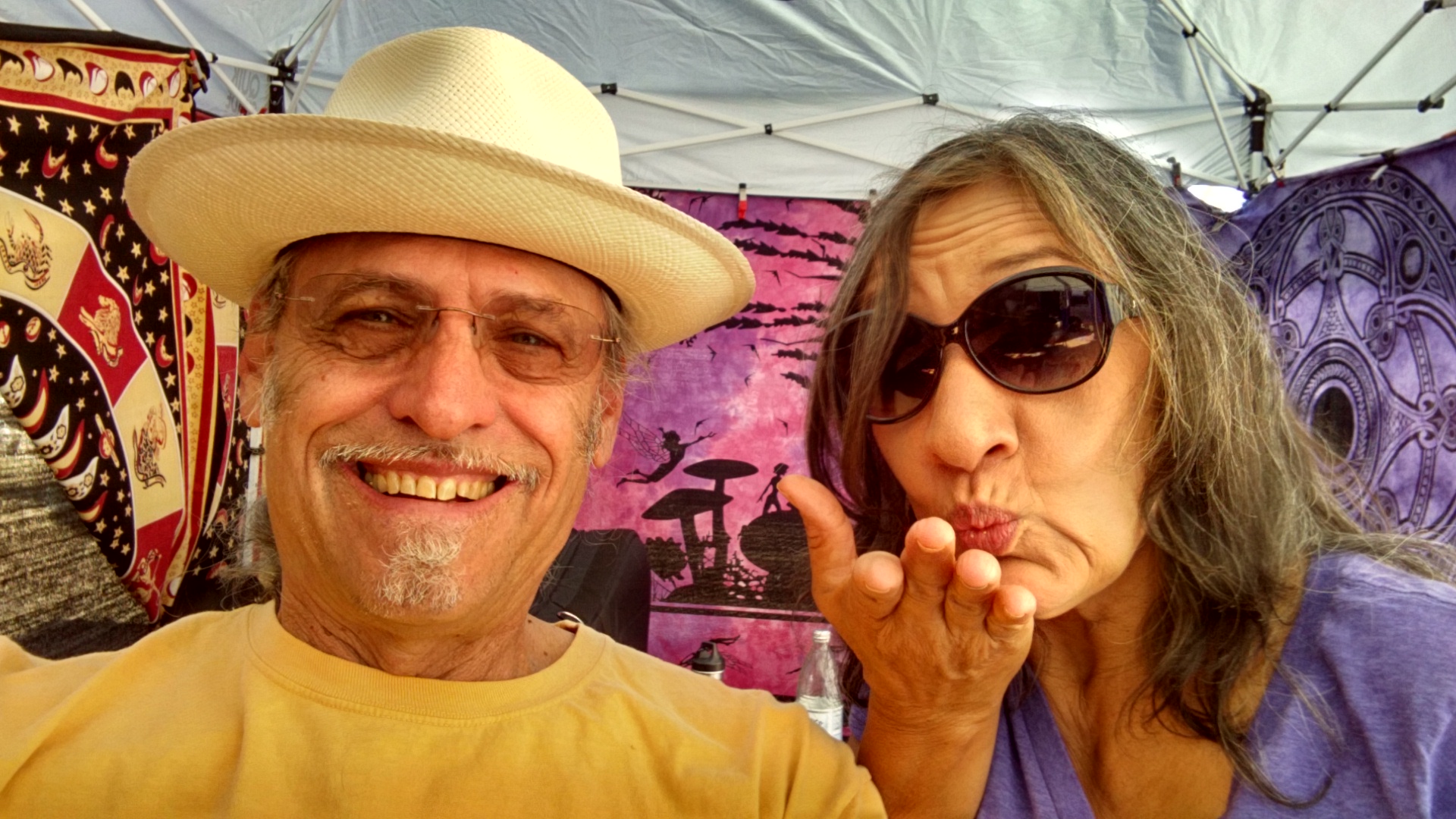
Portland fans are delighted that Chuck and his amazing wife, Emelda, have moved to the area and are carrying on the tradition of great music, great ideas and great fun.
How it started. These things always start with Bill Monroe.
Chuck remembers being a little boy when musical lightning struck. His family was living in Conway Springs, Kansas.
“My dad would come home from work and turn on WSM, and there was Bill Monroe. I heard that big G run in Uncle Pen, and even at that young age, I went ‘wow!’”
The family later moved to Southern California, where Chuck met Emelda in 1972. He remembers the two of them working on their Chevy van in his parents’ driveway one Friday afternoon, when his dad came home and announced he had seen a reader board at Shakey’s Pizza Parlor advertising regular bluegrass music.
And there was no stopping Chuck from there.
He had been teaching himself guitar for years, “But I was burned out on Neil Young and Donovan and Dylan.” He was ready to learn to play the music he loved. When he heard the guitar player in the bluegrass band Hot Off The Press at the pizza parlor, Chuck said to himself, “I can do that!” He began taking lessons from the band’s guitar player, Howard Yearwood.
After six lessons, he realized he didn’t need tab to figure out how to play the melody, and about six months later, he was in a band, playing guitar and singing, of course, at another pizza parlor.
The banjo came second! Most of us associate Chuck with his driving banjo style. But he picked up the banjo only after he performed on the guitar for quite a while. Here’s how it happened.
Southern California was a magnet for bluegrass. So, Chuck was exposed to lots of great music and was going to lots of great jams. And he noticed that some of those jams lacked a banjo – so he decided he’d learn.
A chance opening in a jam opened him to the instrument he’s most associated with.
“A friend loaned me a banjo for a while. I learned some rolls just reading tablature. I listened to Ralph Stanley a lot, because he’s the only one that really talked to me musically. And it sounded doable.”
Curiously, he said, at first, “Earl didn’t do anything for me. I’ve studied with a lot of banjo players through the years.” Today he incorporates Scruggs licks and Don Reno single notes in his playing, as well as borrowing inspiration from banjo players as diverse as Keith Little to Richard Underwood.
Above all, he thinks, the key to good banjo playing is hitting the melody.
Chuck is often referred to as “Chainsaw,” which many of us associated with his powerful banjo sound. But the nickname had a totally different origin.
Chuck said that he and two other banjo pickers, Jay Castleberry and Gord Acri, were enjoying a late-night jam at the Columbia Gorge Bluegrass Festival.
They ventured into the pavilion in the northeast corner of the fairgrounds where “there were some people playing country music. We wheeled in there around 4 in the morning, three banjos blazing, and kind of destroyed the jam. So, someone said we ‘clearcut the jam’.”
It’s been Chainsaw ever since.
And in case you have any doubt about Chuck’s opinions about the role of the banjo, remember his slogan: It doesn’t have to be good, it just has to be loud!
The John Morreau factor. Chuck and Emelda’s history is intertwined with that of John and Karren Morreau, both of whom have passed in the last few years.
All four were living in California, and Chuck and John met when they were both hauling cement for different trucking companies. They had heard about each others’ love of bluegrass, and they met while in line at the General Portland Cement mill while waiting to get their trucks loaded. They became great friends, as did their wives. John had a stunningly moving voice, of which a mutual friend said, “When John sings a song, it stays sung.”
While watching the Super Bowl one year, John noticed that he was seeing a lot more beer commercials than cement commercials. Maybe they were hauling the wrong commodity?
It wasn’t long before both men had switched to transporting beer. Eventually they both moved to Oregon and bought their own trucks. The two families settled in Drain, OR. Eventually, the Morreaus ended up in Junction City and the Holloways settled in Eugene, where they lived for 27 years. And John and Chuck took every opportunity to pick together, including forming the band Blue River.
Bluegrass Music: Drive it Home! During his years in Eugene, Chuck made his mark on Oregon bluegrass. After several years of driving up I-5 monthly to join Portland-area Oregon Bluegrass Association board meetings, Chuck became OBA president in 1997, and the OBA’s core shifted to Eugene. He held that post until 2003.
One of the first things Chuck did was recruit strong female board members and volunteers, including Louanne Clevenger Fugal, Jennifer Campbell and Suzanne Pearce Adkins. “I surrounded myself with women, because they’re powerful. And I think we made big strides.”
With the help of his friend (Dobro) Duane Thompson, the OBA ushered in internet use to reach its members.
Chuck started an OBA jam that lasted for more than a decade, attracting people from both the Eugene and Salem areas to the tiny community of Coburg, just north of Eugene. The most memorable attendee was a young fiddler, Alex Hargreaves – who now plays with Billy Strings.
And for many years, he, often with the help of his group the Green Mountain Bluegrass Band, hosted a jam at the popular Eugene brew pub Sam Bond’s Garage. On nights when no one showed up to jam, he saw a good opportunity for band practice.
During his Eugene years, Chuck,worked as a welder for a motorcoach manufacturing plant and taught and recruited for a nationally known truck driving school. All the while he taught banjo, mandolin and guitar privately and later for Lane Community College and the John G. Shedd Institute for the Arts. He also hosted a radio show (more about that later).
Perhaps one of Chuck’s most long-lasting contributions was creation of the bumper sticker, ”Bluegrass Music: Drive it Home,” the inspiration of a former truck driver whose banjo playing always exemplifies “drive.” At the time, Ricky Skaggs was pushing a slogan, “Pick It Up!” Chuck and the OBA board knew they could come up with something more fitting for the PNW scene.
North, to Portland. About six years ago, Emelda retired from the company where she had worked for 27 years. About the same time, daughter Kellie and her husband, Jared, had a baby girl. The stars aligned, and Chuck and Emelda were able to move up to Portland.
They converted Kellie’s garage into a beautiful 800 square-foot home, so they can be available to do one of the things they love the most – spend time with their immensely adorable and bright granddaughter, Lillian Meredith.
The move to Portland also put them closer to Kellie’s twin sister, Kimberly, and West Lee, their talented and handsome grandson, who live in Seattle. The icing on the cake was the move put them 10 blocks from their son, Chad, and his wife, Sarah.
Chuck says emphatically, “Life is GOOD!”
Chuck already had plenty of musical friends in Portland through the network of the late Chuck Davidshofer. But it never takes Chuck Holloway long to attract new musical partners. And he has surrounded himself with the next generation of pickers who love the classic bluegrass.
Chuck had met bass player Casey Davidson at Weiser during the National Old Time Fiddle Championships. Casey invited him to the jams at Ruse Brewing, There he met Drew Tucker, a tattooed punk rocker with a great bluegrass voice, a hard driving mandolin style, and passion for the old stuff.
One day, Drew learned of a last minute opening at the Starday Tavern. He invited Casey and Chuck, who pulled together a couple other pickers. Knowing the material as well as they did, they performed a creditable three hours of classic bluegrass, without ever having practiced together.
Five years later, Casey, Drew and Chuck still form the basis of Thunder Ridge, which has performed at major Northwest festivals and at many smaller venues. When he’s free of little-league duties, Patrick Connell plays guitar with them, and award-winning fiddler Gary Schuh is the latest addition.
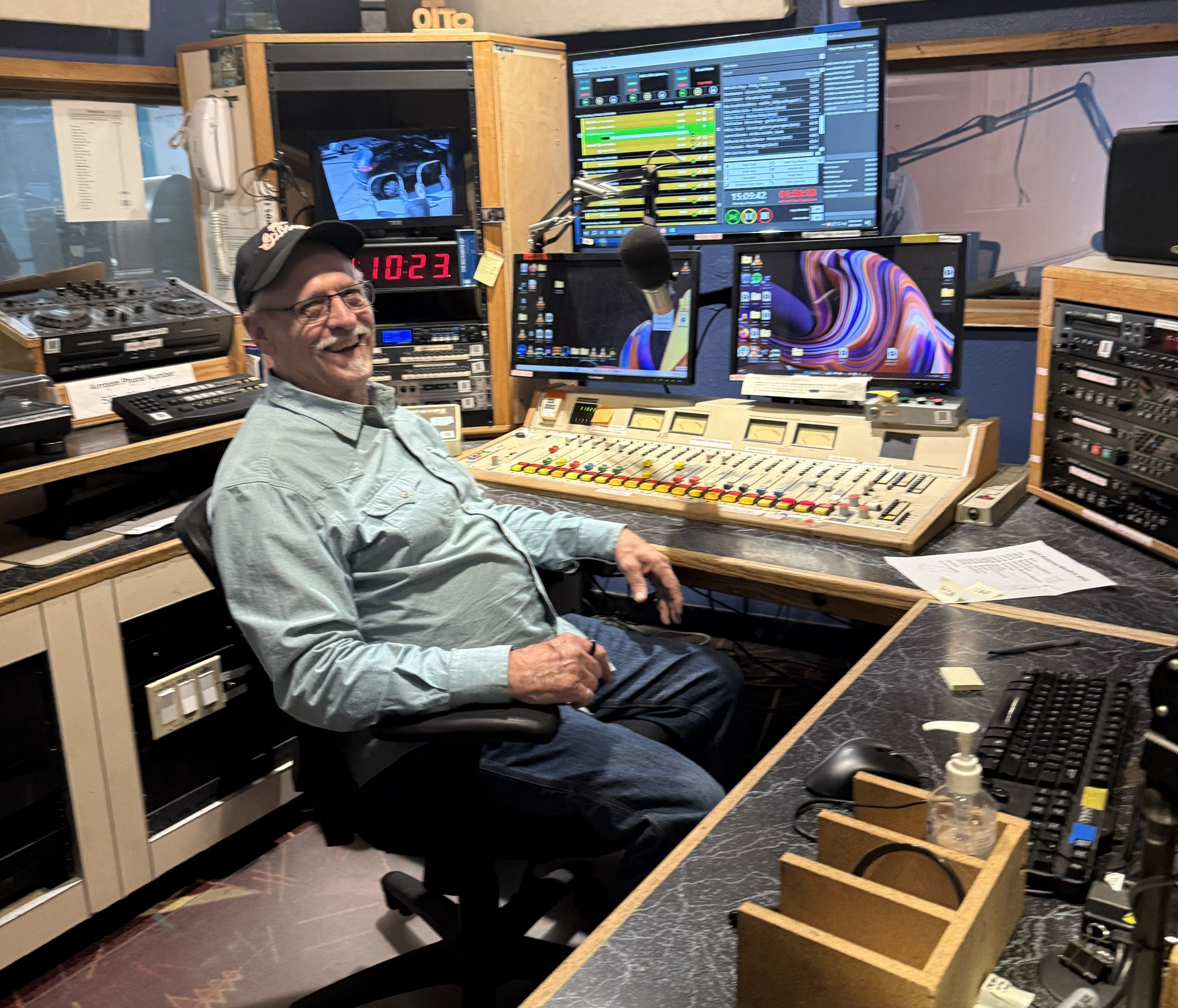
It always goes back to the radio. The first time Chuck heard Bill Monroe perform live on WSM radio determined the trajectory of Chuck’s life. These days, Chuck shares his love, knowledge and enthusiasm for bluegrass with listeners all over the country who stream Music from the True Vine from KBOO Radio.
For five of his Eugene years, Chuck volunteered his Monday nights on KRVM, a listener-sponsored station. Every week, he would bring three suitcases full of about 300 CDs to the station to play the music that lifts his heart.
(Photo courtesy of Melissa Tanguay)
For decades, bluegrass fans have spent Saturday mornings listening to Music from the True Vine – believed to be the oldest continuous bluegrass show west of the Mississippi.. Every Saturday, different programmers bring their unique perspectives on bluegrass to listeners. When the fifth Saturday slot came open and Chuck was living in Portland, KBOO volunteers approached Chuck.
With the strong encouragement of Ken Cartwright – bluegrass musician, luthier, promoter and possibly the state’s fiercest radio advocate – Chuck agreed.
In addition to staffing the occasional fifth Saturday, Chuck is part of a unique arrangement on the second Saturday of each month. From 9 to 10 a.m. he hosts “Chuck’s Obscure Bluegrass Music Corner.”
Chuck draws from digitized versions of about 1,500 albums from his personal collection. He plays the deep cuts – the songs that aren’t well-known and aren’t commonly played, but to Chuck’s ears deserve attention and acknowledgement. It’s like a little music history course every month – available from your easy chair while drinking a cup of your favorite coffee.
The rest of the second Saturday show includes a live studio performance and an hour of recorded music selected by The Banjo Sisters.
These days. Chuck and Emelda’s primary job is helping with Lillian, while Kellie and Jared tend to their demanding day jobs. Chuck is also Mr. Fix-It, a handy person to have around. Even little Lillian knows to bring anything broken to her grandpa, “because Grampy can fix-it."
Those of us who have known Chuck for years are happy that he’s up in Portland and that he has gathered together the musical and family tribe that nourishes his soul.
Chuck would love to see you at any Thunder Ridge show. He’d also love to know that you’re listening to him on the second Saturday of every month – and he’d be even more delighted if you’d contribute to KBOO – the kind of independent radio that is so important in the days of monopoly media.
And here's a sample of Chuck doing what he does – so well!