
The Banjo Sisters: Bringing Bluegrass Home
KBOO radio, 90.7, is amazing in many ways.
And one of the most amazing things about it is Music from the True Vine, which we believe to be the longest-running bluegrass radio show west of the Mississippi, with programmers who have been volunteering for upwards of 40 years.
These days, something else exceptional is going on with Music from the True Vine. It’s the Second Saturday collective, in which two of the stalwarts of Oregon’s bluegrass world and two more recent arrivals team up to bring us the best of bluegrass.
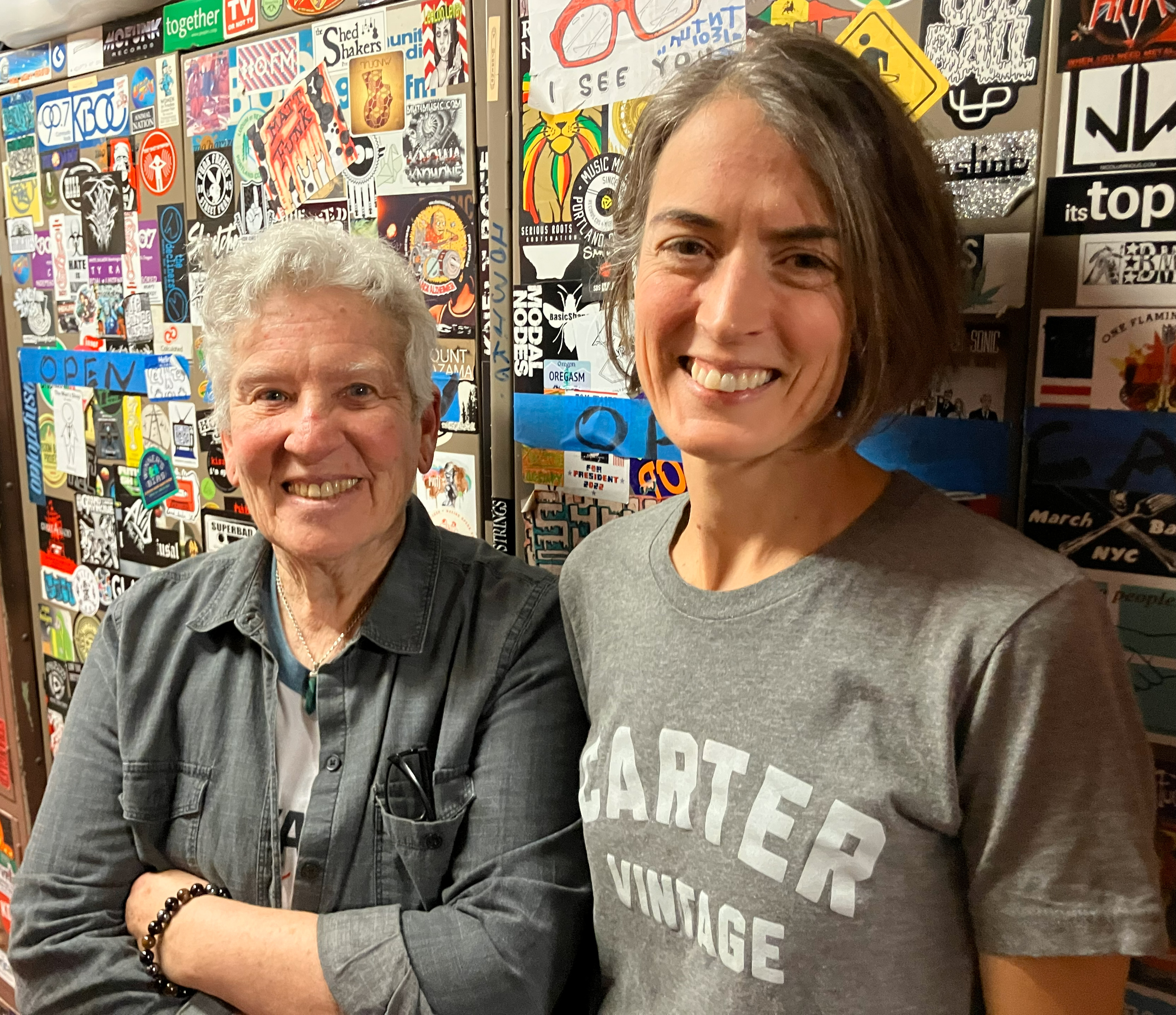
Donna Dunaif and Melissa Tanguay – The Banjo Sisters – are the newest bluegrass programmers. They join Dave Elliott and Chainsaw Chuck Holloway once a month, mixing up the music and bringing new perspectives to KBOO listeners.
Newish to the music
Unlike Dave and Chuck, who are almost synonymous with bluegrass in Oregon, Donna and Melissa are relative newcomers. Both of them got hooked on bluegrass after first getting hooked on the banjo.
Donna has had a lifelong interest in music. Starting on the violin as an adolescent, “I took lessons for about eight years – terrorizing my cat with the high notes. . . I was also teaching myself what I call standard teenage folk guitar . . . I sang along with the Beatles and Simon and Garfunkel.”
After moving from New York to Portland in 1976, she played electric bass as a free-lance accompanist for several community choirs for 20 years. She also played bass in a jazz standards band for several years in the 1980’s.
“Then in 2010, I got it in my head to get a banjo . . . I don’t know why I settled on bluegrass rather than clawhammer, but I fell in love with it, and I haven’t stopped.”
Her banjo purchase coincided with the start-up of Taborgrass, an instructional jam and performance class. There she met new and established bluegrass fans and started her total immersion into the genre.
Curiously – even to herself – Melissa got the idea to play the banjo when she heard Garth Brooks’ version of Callin’ Baton Rouge.
Like many who pick up the banjo, she didn’t know anything about banjo styles. When she started lessons with BB Bowness, the teacher asked what bluegrass Melissa listened to. “And I was, like, ‘what’s bluegrass?’”
“So that began an exploration of starting to listen to the banjo. And I remember that we were learning different songs, and I was learning a banjo break for Down the Road.” She found Earl Scruggs’ version, “And I remember listening to that on repeat driving to and from work, because I was just obsessed.”
Much later on, she learned that Callin’ Baton Rouge had first been recorded by Newgrass Revival, who also backed up Garth Brooks on his hit recording. “So that was Bela Fleck on that recording,” that had turned her on to the banjo. Learning that “was a full circle moment for me.”
Second Saturdays
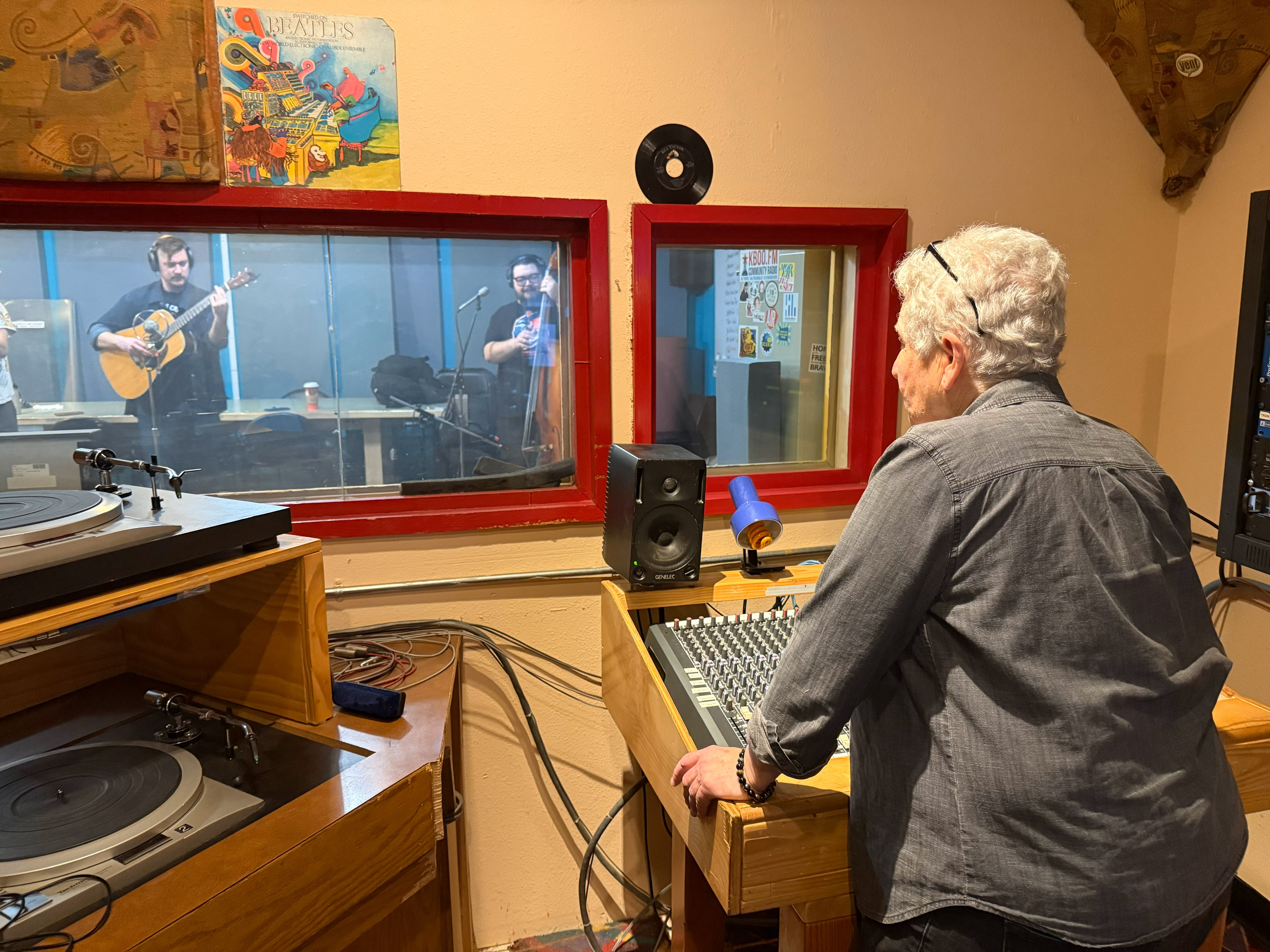
Tuning into KBOO at 9 a.m. on the second Saturday of the month, you’ll hear Chuck bringing traditional style bluegrass from his extensive personal collection. Then at 10, the programmers produce an hour of live music in the studio, featuring the great new wave of Oregon bluegrass bands.
At 11, Melissa reads the Bluegrass Calendar. Rather than waiting for people to send in calendar announcements, Melissa spends some of her off-air time visiting websites, Instagram and Facebook pages to learn who’s playing where – and making sure that information gets passed on every Saturday morning.
Then until noon, Donna and Melissa take turns bringing their favorite music to listeners. Dave Elliott is always in the studio as a trouble-shooter, advisor and font of wisdom!
Melissa remembers Dave’s major instruction as he mentored them in programming. He said, “Just play what you love.”
She said, “I really like following trails within songs. So, I’ll hear a particular break and figure out who’s playing it, then explore who else they’ve recorded with or if they have any solo albums. That’s my process for discovering new music.”
She starts with several hours of music, then narrows it down to one show’s worth . . . which she listens to during her regular runs, refining as she goes to make sure the songs flow smoothly.
Donna said her process is less formal and more intuitive, but similar to Melissa’s. “I tend to go searching for what’s new out there. Then I think in terms of artists who I really like. I’ll pull up an artist and play a bunch of their stuff,” until she hears something that really catches her.
“A song has to grab me because of the lyrics or the theme, the singer’s voice, the instrumentals – obviously ‘more banjo, please.’ But I love waltzes and fiddle stuff.”
Both programmers prerecord their set lists and play them off a laptop – reducing glitches from aging KBOO equipment.
Escape from the First Saturday slot
For decades, the first Saturday of the month was considered “the woman’s slot.” This was certainly an attempt at making bluegrass more inclusive, even at a time when few women were picking. Since Rachel Gold got too busy to help Justin Auld in that slot, all the programmers have been male.
And since the KBOO programmers have been so enduring for decades, there haven’t been openings on other Saturdays. (Dave Elliott and Gareth Jenkins have been staffing the studio since the 1980s. Ian Joel started about the same time, but gave up his slot during COVID, to be replaced with Chip Russell, who had been filling in on the fifth Saturdays. Josh Cole now joins Chip in the regular rotation.)
With the fifth Saturday slot open, Dave Elliott put out the word that he would love to see women programmers in the studio to better reflect Oregon’s bluegrass demographics. Donna and Melissa are now taking some of those fifth Saturdays as well as being part of the Second Saturday Collective.
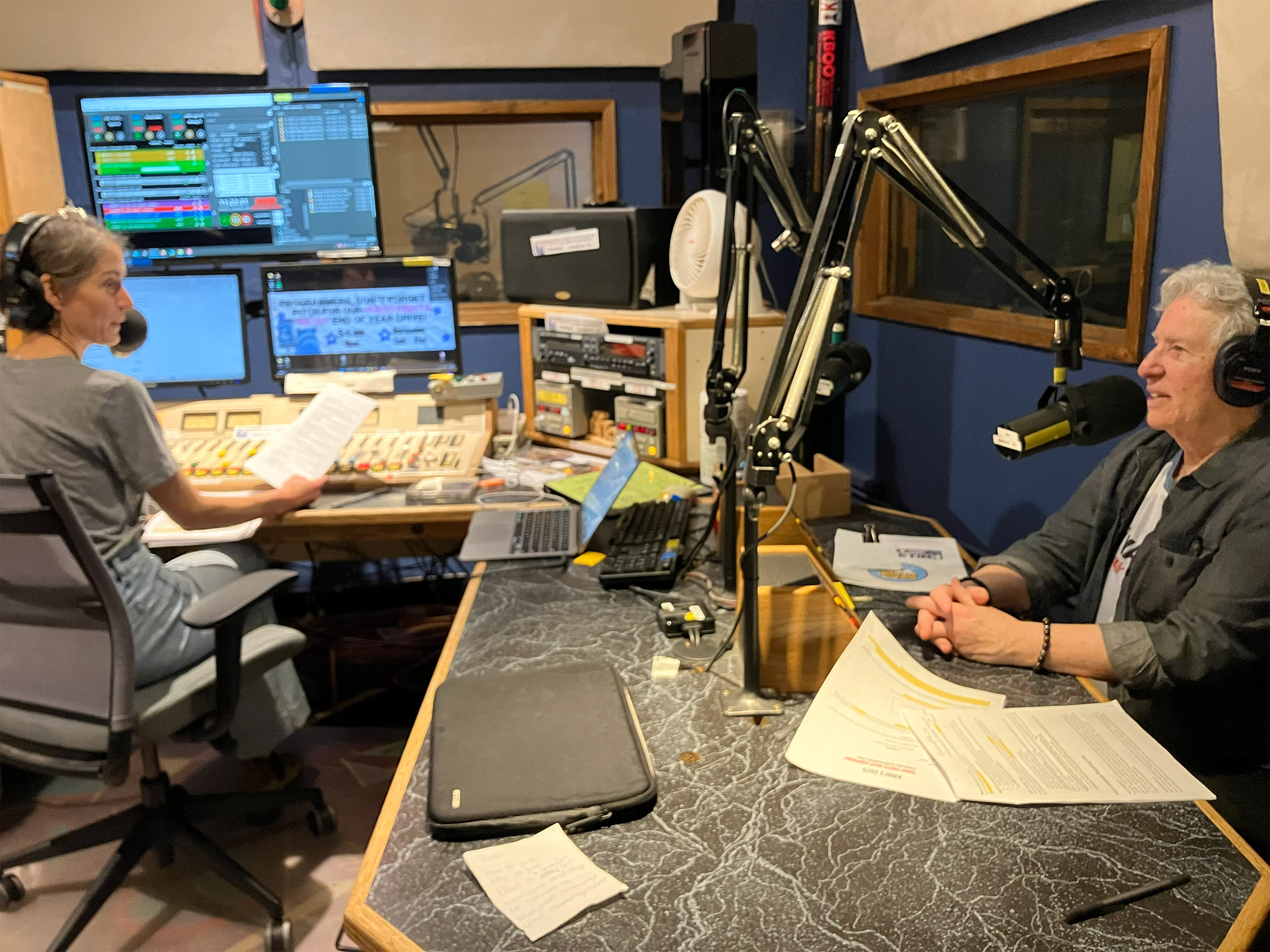
Donna was already interested in the engineering side of music. Her home office is set up for recording, editing and mixing, especially for the songs she writes. So, she was eager to learn more about what goes on behind the KBOO microphone.
And Melissa, who jumps into everything head first, was enthusiastic about learning programming and the studio equipment.
And, they are both clear that while it was a goal to have more women on staff, they never thought of themselves as having “the women’s role.” They have never been expected to play more music by women than the other programmers do – nor do they.
They follow the rule “play what you love.” Women make up a good part of the performers heard on theirs shows, as on all the programmers’ shows: the songs they all love.
In the past, Donna said, you had to work hard to find bands fronted by women and songs sung by women. But today, women are fully integrated into the bluegrass scene, so it’s easy to get a mix of male and female artists without making extra effort.
As an example, winners for the 2025 instrumentalists of the year on fiddle, bass, mandolin and banjo were all women.
Today, it’s all bluegrass.
More than just music
KBOO has become a big part of both women’s lives – and perhaps in ways they never anticipated.
For both, it’s a new way to connect with others who care about bluegrass – carrying on the festival experience throughout the year.
Donna said, “It’s become a lovely part of my community, not just working with Melissa and Chuck and Dave, but also with many of the live bands .” Plus, “I love playing banjo,” she said, “so this is kind of an extension of that.”
Melissa, too, said, “I definitely love the camaraderie.” She is growing her connections as she meets the musicians coming in to perform live. “And I think it’s the music discovery that I really love about it.”
Teaching the teachers
Melissa is particularly proud of a recent discovery that surprised even Chainsaw Chuck.
As she listens and learns, she often comes across performers’ whose names are unknown to her. She noticed the name Stacy York while listening to a Joe Isaacs album, and during her normal process of following the threads, she saw that Stacy had also performed on a Jeanie Stanley recording.
Jeanie Stanley turned out to be Carter’s daughter.
And Chuck had never heard of the performer nor that album, which is a tribute to her father and includes other family members. So, he bought it for himself. Then he reached out to Jeanie on Facebook and recently played two of her tracks on his portion of the show.
For Melissa, that was a milestone. “I actually got to introduce him to a woman bluegrass artist in his preferred style who was unknown to him. I’m giving myself a pat on the back for that!
A final word about KBOO
KBOO has been an invaluable resource for all Oregon since it first went on air in 1968. And it has been the lifeblood of our bluegrass community for decades.
One of the listener-sponsored stations, it remains independent of advertising by surviving primarily on private contributions and some grants – including, until recently, funding from the Corporation for Public Broadcasting. But those funds are no more.
KBOO has always just scraped by. But the need is more urgent now – for all of us interested in different perspectives, and to support a resurgence of bluegrass in Oregon.
So, I’ll just drop this not-so-subtle hint here: https://secure.givelively.org/donate/the-kboo-foundation/kboo-fights-back-end-of-year-drive.
Photos courtesy of Jen Dynes and Melissa.